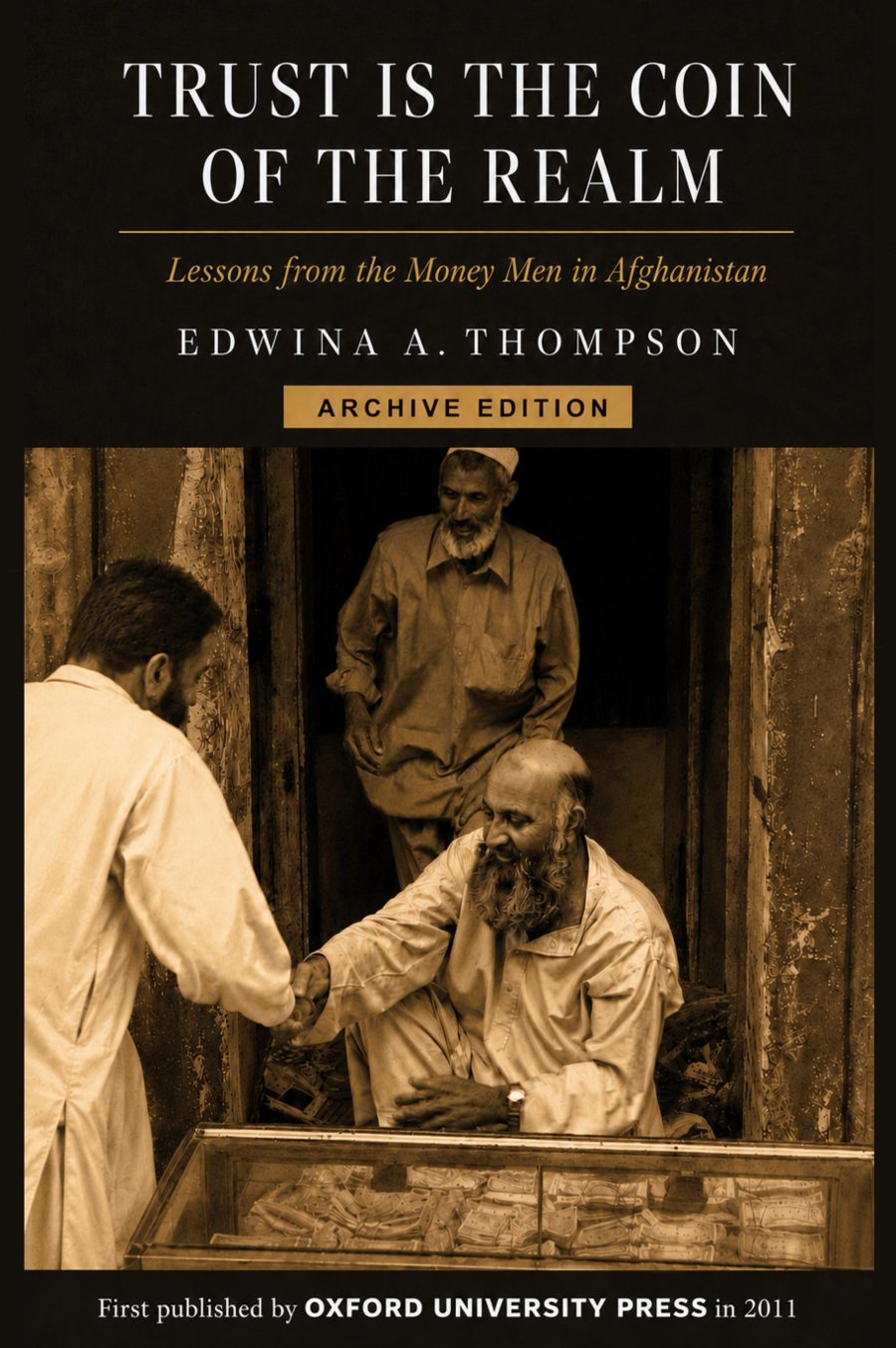
Trust is still the coin of the realm.
Fifteen years after Oxford University Press first published this book, I believe its central argument more strongly than I did when I wrote it. What I understand differently is where the realm actually is.
In 2011, the title referred principally to the money markets I had studied in Afghanistan: networks in which a person’s promise, reputation and capacity to settle could carry value across borders when banks could not. I had gone there after September 11 to investigate a system widely described as a vehicle for terrorism. What I found was neither innocent nor inherently criminal. The same networks carried aid, trade, remittances, drug money and, at times, funds connected to people-smuggling and arms trafficking. The mistake was to assign a moral character to the system itself rather than examine the people, corridors and relationships within it.
The years since have made that distinction more important. Banks and other formal institutions have withdrawn from markets judged too difficult or expensive to serve. Money did not stop moving. It moved through what remained: balances carried between intermediaries, identities known locally, witnessed promises, records kept close to the transaction and reputations exposed to real damage when an obligation was broken.
Fifteen years on, the same word has returned to the heart of the debate. As central banks grapple with stablecoins and tokenised money, the Bank for International Settlements (BIS) — the bank for central banks — has titled a major chapter on money’s future Anchoring trust in money: innovation beyond stablecoins. It asks how the institutional foundations of money can survive digital innovation.
The echo is striking, but the starting points differ. The BIS begins with a functioning monetary system and asks how trust can survive technological change. This book begins where that system does not reach and asks what carries trust there. Afghanistan supplied one answer. The money dealers were not operating outside the financial system. To a very large extent, they were the financial system.
The financial debate is not the only one that has moved. Defence thinking has rediscovered statecraft: power as leverage rather than hardware; timing, chokepoints, industrial capacity, supply chains, and the machinery that turns intention into effect. Analysts now map the journey from upstream raw material to the front line to find where a weapon system’s components can be intercepted, manipulated, redirected or destroyed. It is good analysis. But it remains incomplete if the money is treated as background. In conflict, money is one of the hard operating systems. Who can pay, who can receive, who can move value, who is visible, who is excluded, and what record remains after the transaction are not technical details. They are part of the contest itself.
Money is not simply the fuel poured into the machine after strategy has been designed. It is closer to the sinew within the muscle: integrated through the whole body, giving force its movement, reach and coordination. The old phrase “the sinews of war” still has work to do. Capital determines whether factories expand, whether suppliers survive, whether salaries are paid, whether contractors are chosen, whether civilians can rebuild, and whether promises made in strategy papers become visible in people’s lives.
A Defence, Security and Resilience Bank is now being developed among Western and allied countries to help states finance deterrence, readiness and industrial capacity. That is a serious recognition that capital is not outside defence. It is part of defence. But the same logic must reach beyond sovereign borrowing and major procurement. Conflict economies also need lawful payment channels, liquidity, trusted intermediaries and records that can be reported back to the governments and taxpaying publics funding the work. Without that last mile, money may be committed in one capital city and fail before it reaches the people whose choices determine legitimacy on the ground.
There is now a second meaning caught inside the title of this book. The military abbreviation for counterinsurgency is COIN. In Afghanistan and Iraq, commanders arrived, late and painfully, at a conclusion the money markets could have offered at the start: legitimacy travels through everyday systems. Wages, compensation, remittances, debt, credit, salaries and cash all shape what people believe about who governs, who protects, who keeps promises and who can be trusted. For a time, doctrine said this in unusually blunt language. Money was called ammunition. It was treated as a weapon system. Boots-on-the-ground coalition commanders were given funds and told to use them with precision.
That doctrine contained an insight, but also a confusion. For a brief period, FININT — financial intelligence — seemed to stand beside the better-known intelligence disciplines: HUMINT, drawn from human sources, and SIGINT, drawn from intercepted communications. It became something a strategic planner needed to understand. It could reveal networks, intentions, vulnerabilities and command relationships. Then it receded almost as quickly as it had appeared. In the process, two ideas were often blurred: the intelligence that could be drawn from following money, and the influence that could be exerted by using it. Those are related, but they are not the same. One reads the ledger. The other writes into it.
I watched that shift from the inside. At Fort Leavenworth, I spoke to soldier-scholars from the generation shaped by the counterinsurgency campaigns. In Kansas, I sat with Carl Schramm, whose essay “Expeditionary Economics” argued that rebuilding economic life after conflict should not be an afterthought handed off once the fighting was over. It should be understood as part of the campaign itself. Later, when the coalition against Islamic State formed a group to attack its finances, I was deployed to it from UK defence as an independent expert. Money, once more, was being treated as a strategic lever. Trust really was the coin of the realm. The hardest campaigns of the era had made the pun literal.
This book did not gather dust. I began using its findings as a field manual across the Middle East, North Africa and South Asia, and most recently in the Asia-Pacific: not as military doctrine, but as a way of seeing what had to exist for money to become useful, lawful and trusted after it moved. Its central lesson — that trust-based financial systems could not be understood or improved by dismissing the people, relationships and records that made them work — shaped what I built next. In Somalia, Syria, Yemen and Afghanistan, the research became the basis for practical systems that could move money through difficult markets while making each payment more visible to funders and more accountable to the governments and taxpaying publics behind them.
“Hearts and minds”, after all, were never only about sentiment. Counterinsurgency doctrine often described the population as the centre of gravity. But the population was not an inert mass to be won by messaging. People watched who kept faith with them over time: who paid, who compensated, who protected, who honoured debts, who controlled liquidity, and who could still be found when the promises came due. Trust was what gave that centre its weight. China understands the multigenerational side of influence: infrastructure, credit, access, relationships and patience. Western governments often want the strategic effect without first understanding the financial and social channels that already carry trust, obligation and value.
That question has not gone away. Someone will step into the economic voids left in Afghanistan, Yemen, Gaza and elsewhere. If Western governments do not understand how money moves through those places, others will. Influence will not disappear; it will be financed by someone else.
I have seen the same misunderstanding in quieter forms. In Papua New Guinea, Australia’s effort to counterbalance China through rugby diplomacy risks creating infrastructure demands that others may then be invited to meet. Money can signal friendship and still create dependency, or damage the reputation of the partner it was meant to strengthen, if nobody follows the obligation all the way through. The lesson is not that money corrupts strategy. It is that money is strategy once it begins to move.
Ukraine has rightly changed the defence conversation. The question is no longer only which exquisite system can be bought, but whether states can sustain attrition: ammunition, drones at scale, electronic warfare, air defence, logistics, repair, production capacity and industrial depth. That correction matters. But it should not license amnesia. The irregular wars taught, at great cost, that money, legitimacy and trust are also operating systems of conflict. They do not sit below strategy. They decide whether strategy becomes something people can actually see, use and trust.
The next strategic shock may not look like the last one. It will still have a ledger.
That later story belongs to the shorter companion book, The Other Side of the Coin. It begins where this book ends: when I stopped studying the problem and tried to fix parts of it. It follows those ideas into practice — what experience confirmed, what it complicated, what institutions already understood and why building a workable answer did not automatically create an appetite to adopt it.
This archive edition does something different. It preserves the original field evidence, histories, ledgers and argument. I have resisted the temptation to rewrite the text in the light of everything that followed. Its value now lies partly in its timestamp. It records what I found, believed and could support at the time, before many of today’s technologies, debates and financial products had taken their present form. Corrections of fact belong in the apparatus; hindsight should not be allowed to tidy the research into something it was not.
The one addition is a new appendix containing five diagrams, drawn a quarter-century after the September 11 attacks that set this enquiry in motion. They place the original findings within the longer history of credit and correspondent banking, and alongside the developments that followed — blockchain, de-risking, stablecoins and the BIS’s 2026 framework. They bring the argument forward while leaving the original text intact.
Read together, the books make a larger argument. Trust is not the opposite of control. Properly understood, it is one of the things that makes control possible: a promise that can be tested, a record that can be inspected and a person who remains answerable when the promise is broken.
Much of this book was written before those lessons entered doctrine. It returns before they are forgotten.
Trust is the coin of the realm — and the realm has never belonged only to the people printing the money.
Dr Edwina Thompson
Provence, August 2026Preface to the 2026 Archive Edition · © Edwina A. Thompson 2026